


Commercial real estate continues to gain attention among Indian investors because it offers the possibility of steady rental income, better lease stability, and strong long-term returns. But while commercial properties can deliver higher ROI than most residential investments, the outcomes depend heavily on how smartly the investor chooses the asset.
A high-ROI commercial investment is rarely an accident; it is the result of deliberate evaluation, understanding market behaviour, and choosing a property built around demand rather than assumptions.
Here are 5 practical strategies that actually help investors find high-ROI commercial properties in India today.
Most people assume that a good location equals good returns, but investors need to go deeper. A location is only profitable when day-to-day demand already exists or is expected to grow.
Instead of just focusing on broad areas like “Hazratganj” or “Gomti Nagar,” investors should evaluate:
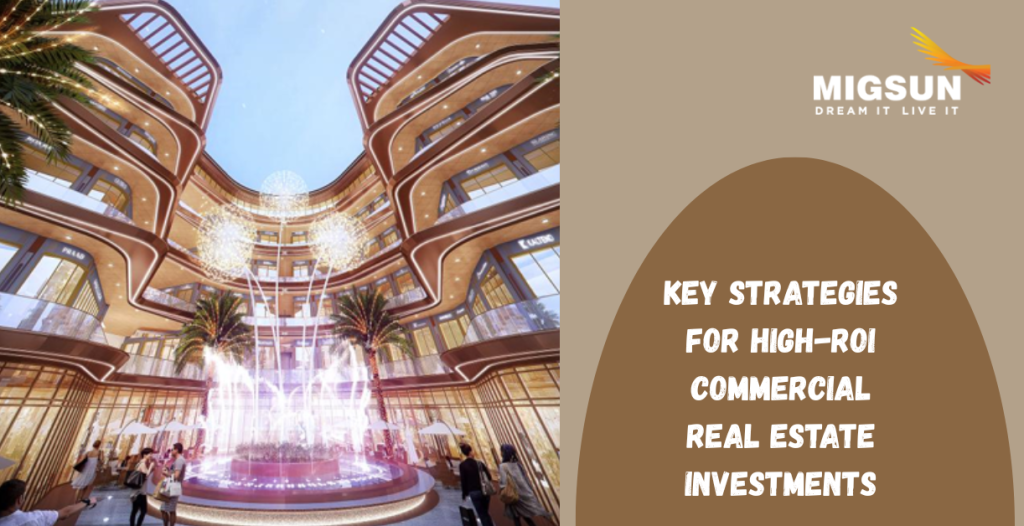
For example, our latest venture, Migsun Lucknow Central, places retail shops, offices, and its upcoming new food court in Lucknow, adjacent to Medanta Hospital, where thousands of people visit every day. DPS Lucknow and Ekana Stadium add additional, predictable traffic patterns. This is a much more reliable ROI indicator than simply being located “in a good area.”
High-ROI commercial spaces depend on both volume and the type of visitors.
Investors should divide footfall into:
A high-end food outlet will not perform well in an area with mostly low-spending footfall. Similarly, a stationery shop performs poorly near a stadium but works brilliantly near a school.
This is why our planning at Migsun Lucknow Central stands out:
Matching footfall type to business type increases ROI more than any interior upgrade.
A commercial property becomes profitable when different businesses complement each other.
Investors should look for projects with:
A mixed ecosystem reduces vacancy risks. For example:
Our project, Migsun Lucknow Central, uses this principle well by offering retail, business suites, and a food court, a mix that helps each segment feed footfall to the other.
Infrastructure shapes commercial success. Investors should prioritise projects near:
For example, Lucknow’s rapid expansion around Shaheed Path has improved connectivity, increased population density, and attracted institutions, making nearby commercial projects significantly more valuable.
One of the biggest mistakes investors make is choosing a “beautiful but impractical” building.
Layout matters more than looks.
A high-ROI project has:
In Migsun Lucknow Central, the planning intentionally places retail shops where natural movement happens, while the food court has both quick-service and leisure appeal. This increases the chance of tenant retention and stable rental income.
At Migsun Group, we prioritise developing commercial spaces that are built on real demand, practical design, and long-term value, not assumptions or trends that fade quickly. Over the years, we’ve seen that high-ROI commercial investments come from understanding how people actually move, spend, and interact within a neighbourhood. This is why our projects, including Migsun Lucknow Central, are planned around institutions, daily footfall generators, and business categories that stay relevant over time.
For investors, the path to strong returns lies in choosing properties that offer natural visibility, a balanced business ecosystem, consistent rental potential, and future-ready infrastructure support. When these elements come together, commercial real estate becomes not just an investment, but a stable, income-generating asset that grows with the city around it.
Whether it is retail, offices, or those planning to buy a food court in Lucknow, the key lies in understanding how businesses and people behave in that specific micro-market.
Also Read: Migsun Lucknow Central New Standards in Commercial Property
To know more about investment opportunities at Migsun Lucknow Central or to speak with our team, reach out today!
Leave a Reply